


Key Takeaways
Introduction
Privacy teams rarely begin a new assessment with a blank page. Somewhere in the organisation, much of the information they need already exists.
Procurement has the vendor details. Security knows which systems are connected. Legal holds the contract. The business owner understands the intended use. A previous DPIA contains the original decision. The RoPA documents the processing activity. A risk register lists the controls that were meant to be implemented.
Yet when a new question arises, the privacy team often has to reconstruct the situation almost from scratch.
Who owns the system now? What data can it access? Has the vendor changed its service? Is an AI feature enabled? Does the original assessment still reflect how the technology is being used? Which controls were implemented, and are the assumptions behind the approval still valid?
By the time those questions have been answered, much of the team’s effort has already been consumed. Risk analysis has barely started.
This recurring information vacuum is the context gap in privacy operations: the distance between what an organisation has documented and what is happening operationally.
Privacy teams have records, but lack a connected picture
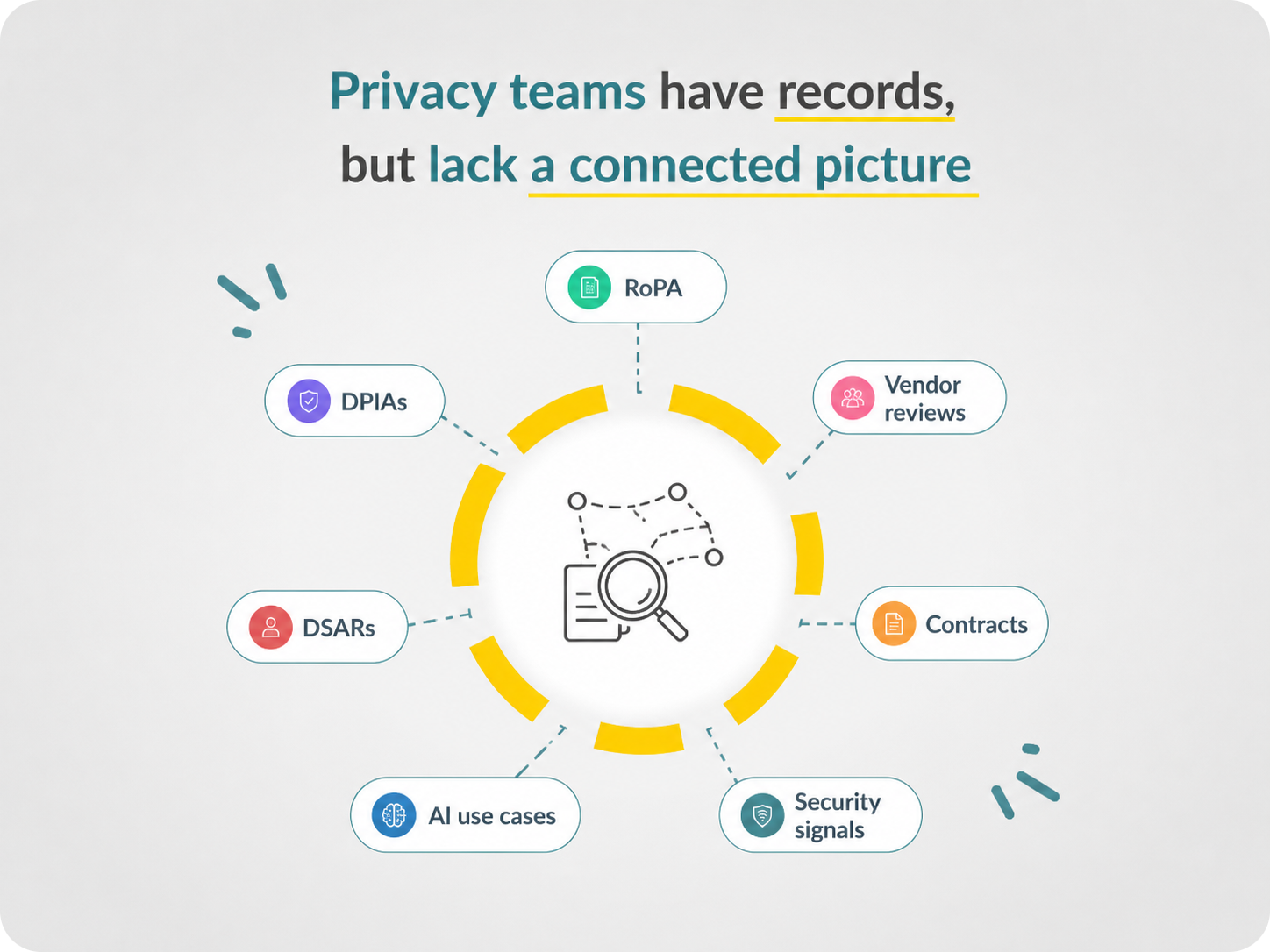
Modern privacy programmes have invested heavily in policies, records of processing activities, data protection impact assessments, vendor reviews, control libraries and request workflows.
These artefacts remain essential. The problem appears when they are managed as separate records rather than connected parts of the same operational environment.
A vendor assessment may confirm that a supplier was acceptable at onboarding. The RoPA may document the processing purpose. Security may monitor traffic between the application and other systems. Procurement may receive updated terms from the provider.
Each function holds a valid piece of information. None necessarily has the complete picture at the moment a decision is needed.
Privacy risk usually emerges from the relationship between these pieces:
- A vendor supports a system.
- The system supports a business process.
- The process uses personal data for a particular purpose.
- The data concerns specific groups of people.
- An assessment approved that use under defined conditions.
- Controls were selected to address the identified risks.
- A later change affects one or more of those conditions.
Without those relationships, governance teams can confirm that records exist while still struggling to understand what a change affects.
A small product update can create a large governance question
Consider a familiar scenario.
A collaboration or video-conferencing provider introduces an AI summarisation feature. The application has already passed vendor due diligence, is widely used and appears in the organisation’s system inventory. Its associated processing activity has been documented in the RoPA.
From the outside, very little has changed. The vendor and product names are the same.
Operationally, however, a new capability may now be processing meeting transcripts, employee conversations, customer information or confidential discussions. It may involve a new model provider, different retention practices or an additional transfer of data.
Security tooling might show that the application is active and connected. That signal is useful, but it does not answer the privacy questions:
Is the feature enabled? Are employees actually using it? Which meetings does it cover? What is the intended purpose? What data can it access? Does it create outputs that influence decisions? Were these conditions considered in the original assessment?
The privacy record can remain technically complete while becoming substantively outdated.
This is one reason periodic governance struggles with modern technology. The change does not always arrive through a new procurement request, project form or formal privacy review. It can arrive through a product release, configuration change or feature activated inside an existing service.
Why another assessment does not close the context gap
The conventional response is often to introduce another questionnaire, review cycle or approval gate.
That may capture the missing information in the immediate case, but it can also reinforce an assessment-driven operating model. Privacy teams spend time triggering assessments, finding respondents, chasing answers, validating submissions and reviewing information that already exists elsewhere in the organisation.
The organisation becomes better at moving forms through workflows without necessarily becoming better at understanding change.
Over time, this creates governance debt. Records contain duplicated facts, unverified assumptions, expired evidence and missing relationships. Each new review becomes more expensive because reviewers cannot confidently reuse the previous context.
The result is a recurring pattern:
- A change or question appears.
- The privacy team cannot identify the complete impact.
- A new information-gathering exercise begins.
- Business teams repeat answers they have supplied before.
- The resulting assessment becomes another isolated record.
- The same context must be reconstructed when the next change occurs.
More documentation may increase the amount of governance data while doing little to improve its operational value.
Technical visibility is only one part of the answer
Privacy teams can learn from security, where operational signals have long supported monitoring and response.
Single sign-on data, for example, can reveal which applications employees are accessing. Procurement systems can surface newly purchased tools. Vendor monitoring can identify changes to terms, subprocessors or hosting. Integration catalogues can show when systems connect to new data sources.
These signals can provide valuable visibility into what is changing.
However, privacy and AI governance also require an interpretive layer. Knowing that a system exists does not explain why it is being used. Detecting an AI capability does not reveal the intended outcome. Seeing data move between systems does not establish whether the use is fair, proportionate or consistent with the original purpose.
The same technology can produce very different risk profiles depending on its context.
A workplace assistant might use calendar and messaging data to answer a harmless question about who will be in the office for lunch. A different prompt could use the same underlying information to identify or accuse employees of undesirable behaviour. The data sources may be identical, while the purpose, effect and potential harm change substantially.
An inventory of tools cannot capture that distinction on its own. Governance needs to connect technical capabilities with purpose, users, affected people, expected outcomes and organisational decisions.
AI can also inherit the context gap
AI is increasingly being used inside privacy operations to summarise documents, extract contract terms, pre-populate assessments, identify missing information and recommend next steps.
These capabilities can reduce administrative work. They can also reproduce the same context problem at greater speed.
Imagine hiring an experienced privacy professional and, during their first hour, asking them to identify the organisation’s highest-risk processing activities. They may know privacy law and recognise common risk patterns, but they do not yet understand the company’s systems, decisions, exceptions, contracts or risk appetite.
Any immediate answer would rely heavily on assumptions.
An AI system operating without current organisational context is in a similar position. Its response may sound confident and plausible while being based on incomplete information.
The quality of governance AI therefore depends on more than the underlying model. It depends on what context the system can access, where that context came from, whether it is current, which permissions apply and where human review is required.
AI can accelerate privacy operations, but it cannot compensate for disconnected or unreliable governance information.
Visibility without prioritisation creates noise
Closing the context gap does not mean sending every system event, vendor update and configuration change to the privacy team.
More visibility can quickly become more noise.
A useful operating model must determine which signals matter. That requires risk-based triage based on factors such as:
- the sensitivity and volume of the data;
- the people affected, including vulnerable groups;
- the purpose and consequences of the processing;
- the jurisdictions involved;
- the level of automation or autonomy;
- the controls already in place;
- the assumptions behind earlier approvals.
A low-risk ownership change might require a simple confirmation. A new subprocessor could trigger a targeted transfer review. Activating candidate ranking in a recruitment platform may require a broader privacy and AI assessment involving legal, security, HR and governance specialists.
The objective is to make routine work lighter while ensuring that material changes become visible early enough for action.
What context-aware privacy operations look like
Context-aware privacy operations begin by observing change where work already happens. Signals can come from identity systems, procurement, vendor documentation, project tools, integration catalogues and direct business submissions.
Those signals are then connected to the organisation’s governance records. A newly discovered application should be linked to its owner, vendor, purpose, users, processing activities, assessments, controls and prior decisions.
Material approvals should also record their assumptions. An employee analytics tool might be approved because it has a limited user population, defined data inputs, meaningful human review and no automated employment decisions. Those conditions become future monitoring points. When one changes, the organisation knows that the decision may need to be revisited.
Finally, context-aware operations need clear human escalation paths. People closest to a use case should have enough guidance to recognise concerns and a simple way to involve privacy specialists before an issue becomes an incident. Automation can gather information, identify relationships and propose actions. Consequential decisions still require accountable judgement.
From document management to operational governance
The context gap explains why privacy teams can have mature policies, detailed records and established workflows while still feeling behind the business.
Documentation remains necessary. Its value depends on whether it stays connected to operational change.
Closing the gap requires privacy operations that can detect relevant events, connect them to existing records, preserve the assumptions behind decisions and route material issues to the right people. This reduces duplicated discovery work and gives specialists more time to analyse risk, advise the business and improve controls.
For TrustWorks, this represents the next stage of privacy and AI governance: moving from isolated compliance activities towards connected, context-aware operations.
Our forthcoming white paper, Bridging the Context Gap: Rethinking the Future of Privacy and AI Governance Through Context-Aware Operations, will explore this operating model in greater depth, including how organisations can connect assessments, processing records, vendors, AI use cases, risks, controls and data subject workflows.
The starting question is simple:
When something changes, can your organisation understand what it affects without reconstructing the story from the beginning?
The webinar transcript frames privacy governance as an increasingly operational visibility challenge, describes the repeated effort required to recover context through assessments, and provides the practical examples involving AI feature activation, single sign-on signals and risk-based triage used in this draft.
